Muslims around the world aspire to visit the House of Allah at least once, yet many do not realise that there are two forms of pilgrimage. Hajj is the major pilgrimage that every financially and physically able Muslim must perform once in their lifetime, whereas Umrah is a lesser pilgrimage that is recommended and highly rewarding. Although they share sacred rituals, they differ in timing, obligation, and complexity.
When most people search “difference between Hajj and Umrah,” they expect a checklist:
Hajj is obligatory, and Umrah is optional.
Hajj has a fixed time, and Umrah can be done any time.
But the real difference goes far beyond that. It is not only about rituals; it is about the journey, the responsibility, the cost, the impact on your life, and your connection with Allah.
This guide is written for everyone who wants to understand the practical, emotional, and spiritual sides of Hajj and Umrah.
The Main Difference Between Hajj and Umrah
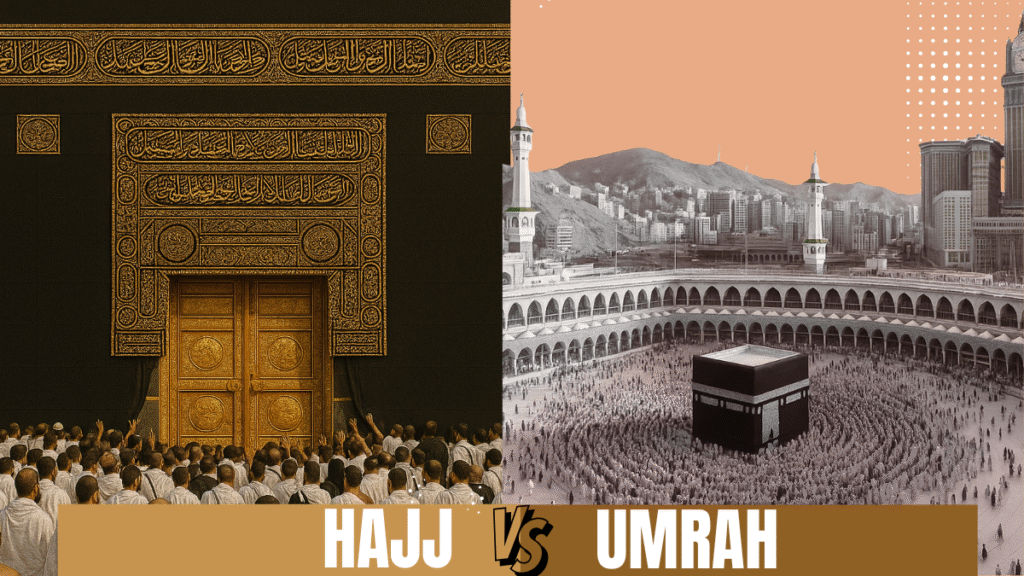
Hajj is one of the Five Pillars of Islam. It is obligatory for every adult Muslim who is financially and physically capable to perform it once in their lifetime. The pilgrimage takes place only during specific days in the Islamic month of Dhul‑Hijjah (8th–12th or 13th) and lasts about five to six days.
During Hajj, pilgrims travel between holy sites around Mecca; they camp in Mina, stand at the plains of Arafat, spend the night in Muzdalifah, and stone the symbolic pillars of the devil at Jamarat. Because it occurs at a fixed time and involves lengthy rituals, Hajj requires more preparation, time off work and travel planning.
Umrah, on the other hand, is a voluntary act of worship that can be performed at any time of the year, outside the days of Hajj.
It consists of fewer rites: entering the state of ihram, performing tawaf (circumambulating the Kaaba) and sa’i (walking between Safa and Marwah), then shaving or trimming the hair. Because it is shorter and does not require travel to Arafat or Mina, it is less physically demanding and takes only a few hours to complete. While Umrah is not obligatory, it is highly recommended, and many Muslims perform it regularly to renew their spirituality.
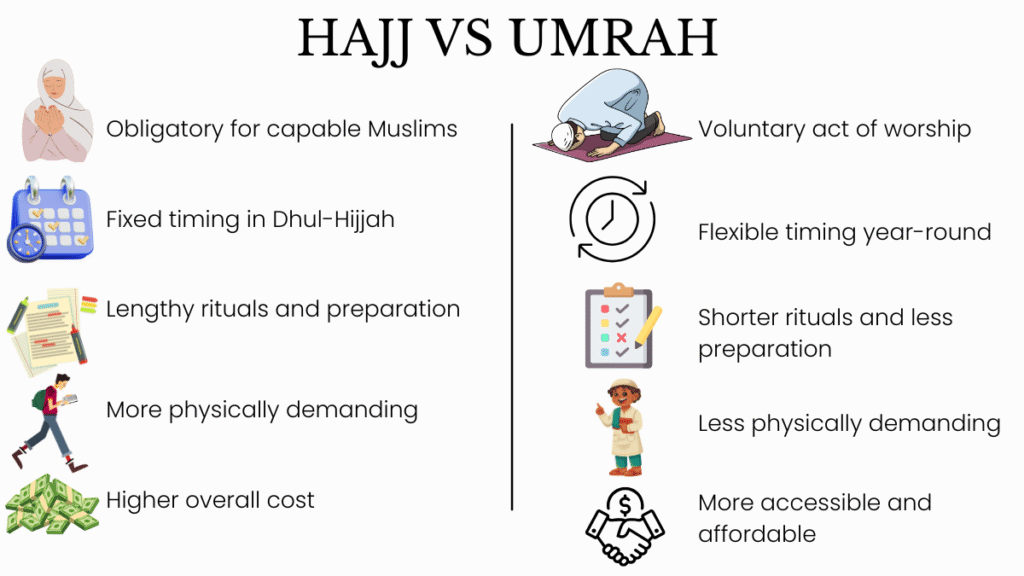
Since Hajj and Umrah differ in both timing and scope, Hajj carries a higher overall cost. Bookings for Hajj in Dhul-Hijjah face intense demand, while Umrah can be planned in quieter months and usually comes with better prices. Many families with elderly relatives or young children view Umrah as a more accessible path to the sacred sites, requiring less physical exertion than Hajj.
Different types of Hajj and Umrah
Every pilgrim’s journey to Makkah is unique, and Islamic law recognises this by providing different types of Hajj and Umrah. These variations are not only rituals but thoughtful pathways that accommodate health, family needs, financial ability, and time.
| Type | Intention | Best For |
| Hajj Tamattu | Perform Umrah first, then Hajj in same season | Most recommended for first-time pilgrims; allows rest between Umrah and Hajj. |
| Hajj Ifrad | Perform only Hajj | Suitable when one does not intend an independent Umrah in the same trip. |
| Hajj Qiran | Combine Hajj and Umrah together | Good for those with limited time who can remain in ihram continuously. |
| Umrah al-Mufradah | Independent of Hajj (Any time of the year except the days of Hajj) | Recommended for those visiting outside the Hajj period. |
| Umrah al-Tamattu | Prerequisite for Hajj Tamattu | Pilgrim should not return home before starting Hajj. |
Similarities Between Hajj and Umrah
Although Hajj and Umrah differ in obligation and timing, they share a core spiritual architecture. The following elements are common to both, and they work together to cultivate humility, discipline, gratitude, and unity.
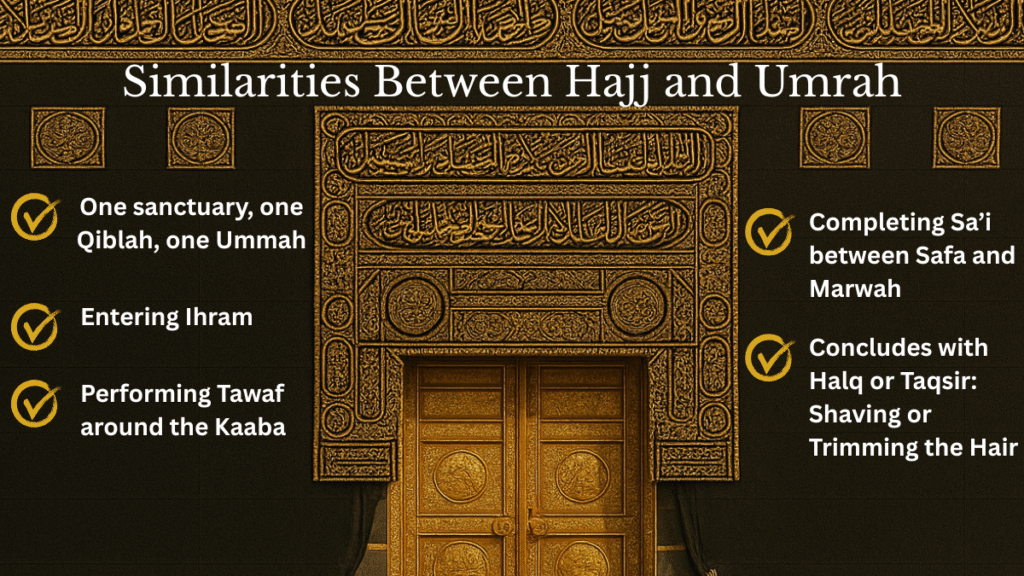
One sanctuary, One Qiblah, One Ummah
Hajj and Umrah take place in the same blessed sanctuary of Kaaba and direct the heart toward the same Qiblah. Each pilgrim experiences the same pathways, recites similar prayers, and follows the same prophetic footsteps. This common ground is what makes both Hajj and Umrah deeply transformative and universally unifying.
Entering Ihram: A State of Consecration
Pilgrims begin both journeys by entering Ihram, which is a sacred state marked by intention (niyyah) at a designated station (miqat).
Performing Tawaf: Seven circuits of devotion around the Kaaba
In both Hajj and Umrah, pilgrims perform Tawaf by walking seven counter-clockwise circuits around the Kaaba, beginning at the line of the Black Stone.
Completing Sa’i between Safa and Marwah
Hajj and Umrah both includes Sa’i, which is the seven-time traversal between the hills of Safa and Marwah. Pilgrims begin at Safa with remembrance and supplication, then move towards Marwah and back, completing seven lengths.
Halq or Taqsir: Shaving or Trimming the Hair as a Sign of Renewal
Hajj and Umrah both conclude with Halq or Taqsir, meaning shaving the head or trimming the hair. This outward change reflects an inward intention to return to daily life with a purified heart and stronger character.
These shared practices of Hajj and Umrah unify pilgrims in their devotion to Allah.
What makes Hajj and Umrah prices different?
The cost of pilgrimage varies by departure country, time of year, and package type. In the Indian context, Hajj packages are arranged through government quotas and private operators.
Recent price estimates show that budget Hajj packages from India range from ₹3,50,000 to ₹8,00,000 per person depending on length of stay and accommodation category. Mid‑range packages, which include better hotels and shorter distances to the Haram, can cost ₹6,00,000 to ₹10,00,000. Luxury packages with five‑star hotels and VIP services can exceed ₹12,00,000, this reflects the premium for convenience and exclusivity. These figures include flights, accommodation in Mecca and Madinah, tents in Mina and Arafat, meals, transport, visa and service fees.
Umrah costs are significantly lower because travellers can choose when to go and how long to stay. A
budget package from India can cost between ₹75,000 and ₹3,00,000 per person. Visa fees range from ₹7,000 to ₹22,000, depending on single or multiple entry visas. Flights typically cost ₹35,000 to ₹60,000 or more, depending on departure city and season.
Accommodation near the Haram ranges from ₹4,000 per night in budget hotels to ₹40,000 per night in luxury properties. Ground transport and meals add another ₹8,000 to ₹20,000 per person. Many tour operators offer economy Umrah packages from ₹69,000 to ₹79,000, deluxe packages from ₹89,000 to ₹1,05,000, and premium package from ₹1,40,000 and above. Travellers can also plan their own itinerary to further reduce costs.
Why Hajj Costs More Than Umrah?
The cost of Hajj is higher than that of Umrah. Several factors drive these price differences:
Fixed dates and limited availability
Hajj can only be performed during a few days in Dhul‑Hijjah. Because millions of Muslims worldwide aim to travel at the same time, flights and hotel rates surge. Accommodation near the Haram becomes scarce and commands premium prices. In contrast, Umrah can be performed year-round, allowing travellers to find off-peak deals and shorter stays.
Comprehensive services
Hajj packages include tent accommodation in Mina and Arafat, transportation to multiple sacred sites, meals, guidance and group services. These add to the overall cost and are essential for logistics and safety. Umrah packages, by comparison, involve fewer days and simpler rituals, so they require fewer services.
Infrastructure and taxes
Saudi Arabia introduced Value Added Tax (VAT) on goods and services, rising from five percent to fifteen percent in recent years, and international inflation has increased costs of flights and accommodation. Maktab charges, meals, visa fees, and local taxes also contribute to the price.
High demand for proximity
Accommodation within walking distance of the Haram costs considerably more. During Hajj, staying in the central area is almost necessary because pilgrims must follow a tight schedule; these hotels charge premium prices. During Umrah, pilgrims may choose affordable lodging further away and use shuttle services.
How Hajj and Umrah Differ in Reward and in the Forgiveness of Sins?
It is common to hear that Umrah can substitute for Hajj, but this is a misconception. Performing multiple Umrahs does not equal one Hajj; the two acts have distinct rulings and rewards. A properly performed Hajj cleanses the pilgrim of all previous sins and grants a fresh spiritual start. Umrah expiates minor sins and provides immense blessings, especially when done in Ramadan, but it does not absolve the obligation of Hajj
Conclusion
Deciding between Hajj and Umrah depends on your situation and stage of life. Hajj is a once-in-a-lifetime duty for those who are healthy and can afford it. It brings deep spiritual cleansing and a strong feeling of unity with Muslims from around the world. Umrah is not required, but it is flexible and very rewarding. You can do it any time of the year, either to prepare for Hajj or as a standalone act of worship.
Both pilgrimages share key rituals that connect us to the teachings of the Prophets Ibrahim and Muhammad (peace be upon them). However, they differ in timing, scale, and cost. By understanding these differences, planning ahead, and choosing the right travel package, first-time pilgrims, families, and seniors can choose a journey that suits their faith and practical needs.
You may do Umrah first to get familiar with the holy sites, or you may save and plan for the obligatory Hajj. In both cases, the journey is a strong reminder of faith, humility, and the unity of the Muslim community.
Frequently Asked Questions
How Many Umrah Is Equal to Hajj?
Many people ask whether performing multiple Umrah acts equals the reward of one Hajj. There is no set number of Umrah that equals the obligation of Hajj; the two are separate acts of worship. However, a hadith reported by Ibn Abbas narrates that the Prophet Muhammad said that performing Umrah during Ramadan carries the reward of performing Hajj with him. Scholars clarify that this is a similarity in reward and does not replace the obligation of Hajj; one who performs Umrah during Ramadan still needs to perform Hajj when able.
Is Umrah Required for Hajj?
The obligation of Hajj is fulfilled independently. If a person performs Hajj without first doing Umrah, their Hajj is valid. Umrah is a distinct act of worship; while combining the two is commendable, the absence of Umrah does not invalidate Hajj. Muslims who cannot afford the added cost of Umrah or who have limited time should not feel compelled to add it to their Hajj; they can perform Umrah later when convenient.
Which Prayer Equals the Reward of Hajj and Umrah?
A hadith narrates that whoever prays the dawn prayer (Fajr) in congregation, sits remembering Allah until sunrise, and then offers two rak‘ahs of prayer will receive the reward of a complete Hajj and Umrah. Scholars point out that this equivalence refers to reward only and does not replace the actual obligation. It is a reminder that simple acts performed with devotion can carry immense spiritual benefit.